Friday, January 19, 2007

Do you rave?

Peas disclosed her status as a closet raver and got me reminiscing.

I guess any mass human synchrony that also has people completely caught up in their own space has to be amazing. Especially since many can be stoned out of their minds and others are health ravers and just drink water.

I used to love a pretty hard core dingy rave club in Cape Town called Pure. It was very hard core though. Once, I passed on a speaker there. Nobody can quite believe that.

Mega-raves are the biz though. I've been to multiple Paul Oakenfold raves. Biggest was at Dockside in Cape Town. They oversold the event by 100% (I'm not quite sure how you do that) and you could tell inside - the crowd literally moved as one - there was no space for individual movement.

The night before the Dockside rave, I stumbled upon James Small's engagement party to Christina Storm at his then Cape Town club (I forget the name). For some reason he allowed my friend and I in and we partied with all the models from Christina Storm's agency about an arm's length away from Oakenfold on the decks. Did you know he earns up to R250 000 per mega-rave gig and was at that stage the highest paid DJ in the world?

I also went to 2 Paul Van Dyk raves. Van Dyk is the godfather of trance. Man. Awesome.

I also had such a good rave with Oakenfold at the Atlas Studios - one of the best venues I've been to - that I wrote my car off on the way home. I've been a little more circumspect about things since then.

Great rave DJs read a crowds' energy and can build to a crescendo of racing heart beats and whooping ravers without the crowd being conscious of the patterns. It is amazing how a poor DJ can have great music but fall flat.

Nexus is cool. Try it. But Truth in Midrand has been the rave destination of choice in Jo'burg for a while and hosted tonnes of big name DJs. I saw Mylo there but he played speed garage and I hated it.

My favourite Jo'burg rave jol was a small dingy place in Benmore Jo'burg called Sublime. Oh my oath, I don't know how I survived! No big name DJs, just a completely different scene.

I also raved to John Digweed in New York and did the obligatory pilgrimage to Ministry of Sound in London (a night out there could break the bank).

Other amazing dance clubs (mostly house rather than rave) have been Jet Lounge Cape Town (all time fave), The Fez Cape Town, Mumbar Cape Town, The Gallery London. Sadly Joburg doesn't have too many out-and-out dance clubs like that, except on the East Rand and the drive home is therefore fraught with danger.

If 27 is a rave rabbit, I hate to think what 33 is! But alas, I find it takes me bloody ages to recover from a rave these days and I go on the rare occasion (like once or twice a year) - typically when I'm drunk after having been somewhere else.

At the beginning of this last December a friend had the great idea (not) of getting up and going to a trance party at 04h00 and partying into the day. I thought it was a crazy idea but went along with it anyway. It was one of those Alien Safari things I think. I arrived and, sober, walked through the tent village with the merchants selling their hubbly-bubblies, health drinks, mushrooms, etc. By the time I got to the dancefloor, I thought I was in a Harry Potter movie. Wow.
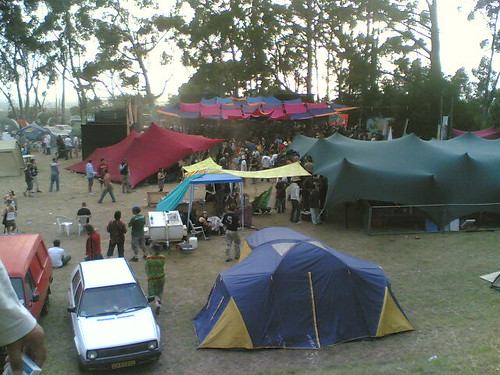
alien safari tokai rave tent town at dawn

Other big outdoor raves have been Carl Cox at a New Year's party on Cape Town's foreshore and another New Year at the River Club (also in Cape Town) - probably about '94 when rave was at its peak. Both had over 30 000 mad ravers!

Still to do:
- H20 (although I thought they were no more)
- The Fridge, London
- Ibiza
- DJ Tiesto
- Junior Jack

I also have to do Carfax although that's more House.

Hey, what memories! I've posted this on my blog for posterity with a photo of the dancefloor from December's Alien Safari at dawn.
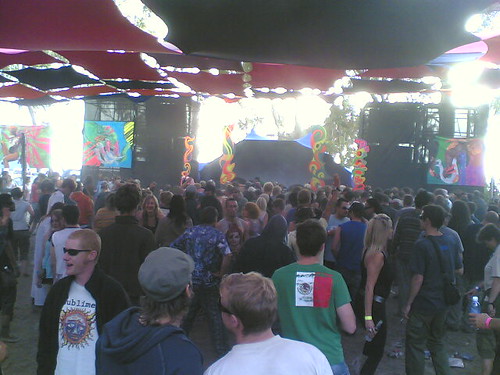
alien safari tokai rave dancefloor at dawn

Tuesday, January 09, 2007

To the future or because of the past?

I just saw The Butterfly Effect.

Click here for the Apple Quicktime trailer.

We all take what means most to us personally from these type of movies but it was certainly poignant for me. I took much of last year off to deal with some issues from my past and consider my future.

SPOILER WARNING - you'll want to skip to the end if you haven't seen the movie and still want to.


Apparently the DVD has an alternative ending and theatrical ending in addition to the released movie. I didn't like what I read of either and I would have gone with yet another version.

The movie ends with Kutcher altering reality and settling for the version which is not quite perfect but does the least harm to everybody.

The moral of the story is that "if you change one thing, you change everything" (the tagline of the movie), and that it is pointless to wish we had done one thing differently in our past - we have no idea how this would have affected everything else. Given this, I would have ended the story in the asylum with Evan (Ashton Kutcher) desperately asking for his journals and trying to go back in time to change just one more thing. It would have rounded off the moral - if you live in the past, you are doomed to remain there. It would have left us with the message but wondering if Evan had merely imagined his alternate realties on the way to ending up in the asylum.

But anyway, we take what means the most to us, and that is what meant a lot to me.

END OF SPOILER

The year ahead must deliver. I have promised myself that it will deliver career wise and financially. It kind of has to to make up for the cost of the last year! But the last year was important and I am ready for new challenges.

So onwards it is.

Sunday, December 10, 2006

How much of the future is digital?

I just watched Happy Feet in South Africa's first digital projection cinema - being trialled at Sandton City.


I must say it was very impressive. The Christie CP 2000x projector shows 35 trillion colours in phenomenal high-definition.


It also means we're a long way to a fully digital movie process - unbelievable animation all the way through to distribution and projection.

I remember some years ago watching a program about the future of movies and forecasting the return of legends like Marilyn Monroe - as digital actors in movies.

PS: the highlight of the movie for me was as the Amigos (pictured above) sang Chicago's If You Leave Me Now, they reached the point where the chorus kicks in "ooo-ooo-woo-hoo no, baby please don't go" the Amigo's paused slightly longer than the original and two guys in the back sang out "ooo-ooo-woo-hoo" in perfect unison. The entire audience fell off their seats in appreciative laughter!

Friday, December 08, 2006

Do men imitate James Bond or does James Bond imitate men?

You've got to wonder how much Ian Fleming's writing has sculpted modern man. To what extent do we aspire to animal magnetism, fast cars, gadgets and that "Peter Stuyvesant" lifestyle - ski-slopes, casinos, 6 star hotels - due to the iconic lifestyle of an improbable superspy?

I recognise it it in myself and some of my friends. Of course it's more acceptable as a twenty-something gung-ho student than a thirty-something married man with kids (not that I'm that!) The irony is that if the Bond lifestyle was achievable at all it would be in our thirties or forties.

So what does the change in the action-hero/spy-genre say about modern man? Casino Royale marks the rebirth of Bond in the form of Daniel Craig. We've had the suave in Roger Moore and Pierce Brosnan. We've had the more masculine before in Sean Connery and Timothy Dalton. The previous return to a more realistic, gory action pic in the Living Daylights proved to heavy for most audiences. And people grimaced at the prospect of the more raw, less attractive Daniel Craig as the new Bond.

But since the Living Daylights we've had The Bourne Identity and Supremacy. Perhaps these more than other movies showed the potential for success of a good action / spy / thriller story.

Also, we've reached the second millenium. The date that prefixed many of the science fiction stories that gave glimpse to futuristic gadgets has come and gone and today's audiences are much less awed by fancy toys.

So Casino Royale redefines Bond and it is welcome and well pulled off. Daniel Craig is the new rugged.


What does this mean for us guys? We need to be able to fight. Not with guns or mamby-pamby shit like that, but in hand-to-hand combat like Matt Damon in the Bourne Identity or Supremacy (yeah dude, who needs a gun when you've got a rolled up magazine...). We need to work out - Matt Damon and Daniel Craig's physiques are part of their movies. We need an Aston Martin. Ok, that requirement hasn't realy changed in the Bond movies. We need to play poker. Right, that might be the worldwide Texas Hold-Em phenomenon influencing Bond rather than the other way around. Also, we only need to attract one super model (in Bond's case - just Franke Potente in Bourne's) per movie, rather than the multiple number of Connery's days. Perhaps that's a concession to to more modern day political correctness. Also, we need to show feelings. We actually need attachment!


Ah well, martial arts here I come...

Saturday, November 11, 2006

How fast can Karma oscillate?

So when I thought Karma was beginning to turn in my favour, I crash my car.

Fark. Friend's wife asks if I can take her for a spin, 'cause it's a sports car, and the back spins out on a corner I took too fast. Result is that I went up on a pavement on which the thoughtful house owner had mounted those little wooden bollards. Hitting them took out what at this stage appears to at least be my aircon and some damage to the bumper.

With my final presentation to my client tomorrow and Monday and a big interview this week, I thought things were turning my way.

All that I can do to avoid feeling the victim of a karmic downturn here is to say, "Karma, smarma."

But the thought of the wasted money on the cost of the damage is just killing me. Aaaargh!

Saturday, October 21, 2006

The real Matrix?

Second Life is hitting all the headlines.

It's a virtual world where anybody can participate in building an online life through a graphical world like that seen in computer games such as Quake and Doom. In fact it is interactive like those but in the mold of SimCity.

But it is more than just a SimCity with other players interacting with you. Yes you can build your own virtual house, etc, but you can also set up a virtual frontend to your real business!

Stores in Second Life do millions of US Dollars of transactions each month.

Perhaps this is the next step in ecommerce. Books may sell through the traditional browser, but goods demanding a more tactile experience such as clothes have battled to achieve the same level of success.

There are over 1 million residents of Second Life. Quite a market!

Here it is in their words:

Second Life is a 3-D virtual world entirely built and owned by its residents. Since opening to the public in 2003, it has grown explosively and today is inhabited by a total of 1,049,836 people from around the globe.
  • From the moment you enter the World you'll discover a vast digital continent, teeming with people, entertainment, experiences and opportunity. Once you've explored a bit, perhaps you'll find a perfect parcel of land to build your house or business.

  • You'll also be surrounded by the Creations of your fellow residents. Because residents retain the rights to their digital creations, they can buy, sell and trade with other residents.

  • The Marketplace currently supports millions of US dollars in monthly transactions. This commerce is handled with the in-world currency, the Linden dollar, which can be converted to US dollars at several thriving online currency exchanges.

Welcome to Second Life. We look forward to seeing you in-world.


Picture: Second Life


Now imagine where this could go. I firmly believe that we are not far away from having sensors create visual overlays to what we see in the real world. These will replace monitors. Already, you can buy glasses with a display built in. Certain games overlay graphics over your real surroundings for a kind of hybrid real / virtual version of your favourite shoot-em-up.

Think of what a limitation the 2D 15-inch (or even 19-inch) monitor is in front of you. Imagine rather seeing computer documents on your physical desktop.

The idea of a person's mind taking over the graphic display is old. It has of course featured in the Lawnmower Man, Johnny Mneumonic and most famously the Matrix. I am sure there are many more.

The best I ever saw, however was the virtual information system in the movie Disclosure. It took the most tried computer concept - the computer as a filing system - and built a virtual world that made the concept a richer experience.

Now combine that with a world like Second Life and the computing paradigm is changed forever!

Wednesday, October 18, 2006

UPDATE: Baboing?

The Cape Town baboon war has been reported in National Geographic and then linked to in that directory of wonderful things, Boing Boing.

The Boing Boing entry mentions the problem but not the latest sad news regarding the poisoning of the baboons and through transmission, head of Baboon Matters, Jenni Trethowan.

Previously:

What do you call these guys?

Who are these friggin heartless creeps?

Monday, October 16, 2006

So which celebrity chef are you?

I'm a bit of a food nut. Not that I'm all poncy about food and restaurants, I just love good food and get cross about wasting money on bad food.

I'm getting better at cooking too and really enjoy myself in the kitchen. I'm from a line of chefs, so perhaps it is in the blood - except that my cheffing is purely for fun and remains mostly aspirational.

So I watch quite a bit of BBC Food - the food channel on DSTV in South Africa. Tonight was Gordon Ramsay night and featured the first episodes of "The F Word" and "Ramsay's Boiling Point." The latter was filmed when Ramsay struck out on his own as a 32 year-old two-Michelinned star chef looking for his third in 1998. The former is more recent.

Ramsay is infamous for his foul mouth and fiery temper. Boiling Point exhibits this well!

Watch the beginning of Ramsay's Boiling Point Episode 1 here From the Biography Channel


Regardless of how nice a chef is, kitchens are typically where tempers are raised. Those who have watched Jamie's Kitchen will have seen exactly this with all-round nice guy, Jamie Oliver. A friend is a chef and has told me about how she had pots thrown at her while training in one of South Africa's top kitchens!

Watching made me think about my natural leadership style. I have to admit, my natural (although repressed) leadership style is more like Ramsay's. This is not good and therefore the repression.

I wondered about this and why I have that streak. Perhaps it is because my first job was as a waiter with a boss like Ramsay! It is also because I have been bred in a high-stress environment - management consulting - over 10 years (7 longer than the average consultant lifespan). Because of all of this and my natural makeup, I cannot abide poor standards and excuses. I also demand total commitment which sometimes pushes people to breaking point. I have been responsible for my share of tears and frayed tempers although these have been evoked through my quietly stated disapproval rather than Ramsay's brand. People either sought to work on my teams or desperately tried to avoid them.

Ramsay grills a contestant in Hell's Kitchen, a game show he hosted


All of that said, I seldom lost it and don't think I ever swore at anyone. That probably wouldn't have worked with the over-achievers / prima-donnas I managed. But sometimes I wanted to! Watching Ramsay made me remember that.

Gary Rhodes Picture: BBC
It is funny how self-awareness also makes one more aware of a more appropriate aspiration. My aspirational celebrity chef? Gary Rhodes, the once-spiky-haired nice-guy chef. I'll bet he gets more out of his staff too.

Which celebrity chef are you?

Links:

Ramsay's biography
Gordon Ramsay's website
The BBC Food website
The Gary Rhodes website

Tuesday, October 10, 2006

Has Google done the math?

Picture: Peter Forret
$1,6bn. Wow. It made the mainstream headlines of South African news. It is a lot of money for a business that's not making a cent. That's what Google paid for YouTube.

Google has made other big purchases - including a stake in AOL from Time Warner at $1bn for 5% [source]. But I guess this one has all the romance of another dot com fairytale.

Speaking of fairytales, is Google too good to be true?

Google’s market capitalization at $110 billion is larger than Coca-Cola’s $98 billion and over twice Yahoo’s $46 billion [source].

If Google were an established business, one branch of theory would expect it to return earnings equal to its weighted averaged cost of capital (WACC) - basically the average of what shareholders and creditors expect back on their funds invested/lent to Google. Using the Capital Asset Pricing Model, Google's WACC could be estimated at 14,7% [source]. That would imply (based on Google's market value of $110bn) that Google would have to return $16,17bn per annum in earnings.

Google earned $6,139bn in revenues and $1,465bn in earnings for the financial year ending in December 2005 [source].

For 2006, Bear Stearns raised its revenue estimate to $6,8 billion from $6,55 billion. For 2007, Bear raised its revenue estimate to $10,1 billion from $8,3 billion (in April 2006 - prior to the YouTube acquisition) [source].

This after the 2005 earnings disappointed the market and resulted in a 20% knock to Google's market value.

But the numbers above show that market value to be inexplicably overstated. Even if you could guarantee Google's future earnings at $16,17bn (which is many a mile from today's $1,465bn), you'd have to reduce the company's value based on the time it woud take to achieve those heady heights. Would anybody guarantee earnings larger than those of Microsoft? And when would they be achieved? For every element of doubt, investors reduce the value of a company. There hasn't been any of that wisdom in the valuation of Google's shares.

Google's most recent acquisition was funded through shares issued to YouTube investors. Effectively this has increased Google's valuation by the same amount - as opposed to a cash acquisition which would have resulted in a commensurate outflow.

Based on the same Cost of Capital theory as above, the additional capital invested in YouTube requires an additional $243m in earnings or an additional revenue of $7,1bn (based on the same net margin as 2005) per year.

So let's recap:
  • Google currently makes $6,139bn in revenues and $1,465bn in earnings.

  • On Google's current market value, Google should earn $16,17bn per annum in earnings implying revenues of $472bn -based on Google's current net margin (ridiculous of course - investors expect Google's net margin to improve over time, reducing the implied revenue figure - still compare those revenues and earnings to those of Coca-Cola for 2005: $23,1bn and $4,9bn respectively or for Microsoft for 2005: $39,8bn and $12,3bn respectively - ridiculous?)

  • The YouTube acquisition increases that required revenue and earnings figures by $7,1bn and and $243m respectively.

Let's try and put those earnings figures in perspective:

  • Advertising makes up 99% of Google's revenues. Advertising has accounted for an increasing share of Google's revenues for each year since 2001 [source].

  • Google pays cost of acquisition costs (payments to Google network members of roughly 40% of those ad revenues, dropping from 48% in the first quarter of 2004) [source]. This is a strong motivation for bringing companies like YouTube inhouse or developing their own traffic (which they tried to do unsuccesfully through building Google Video as a competitor to YouTube).

  • The entire US online advertising market was projected to be worth $15,6bn in 2006, up from $12,5bn in 2005 [source].

  • Online advertising spending accounts for 5% of total media spending and is forecast to grow to $55bn by 2010 [source].

  • Search is by far the most lucrative area, accounting for 40 percent of the total online ad spending in the U.S., according to JupiterResearch [source].

  • The amount being spent on Internet advertising is growing, but the rate of that growth in the United States is slowing slightly, from 32,5 percent in 2004 to 30 percent in 2005 [source].

So could Google get its $16bn of earnings from the search market? Unlikely without it owning the whole market, that market growing substantially and Google massively increasing its net margin.

Clearly Google are focused on improving their margins and this must be the primary reason for bringing a network site like YouTube inhouse - it avoids that 40% they pay to acquire those eyeballs.

So let's look at the revenue potential of YouTube.

Around the world, people watch videos on YouTube more than 100m times daily. About 65 000 clips are uploaded on to the site every 24 hours and the monitoring agency Hitwise says YouTube accounts for 60% of all videos viewed on the net [source].

While Google operates a variety of advertising placement methodologies, let's simplify things and assume only a cost per thousand impressions (CPM) model (a cost per clickthrough - CPC - model is favoured by advertisers).

Let's assume (generously) that YouTube users view 2 YouTube pages for each video they watch, implying that the site generates 200m page impressions per day. On Google's CPM model of $5 per CPM, that's $365m in revenues per year - saving the 40% cost of acquisition is a $146m saving per annum. You'd have to subtract any costs of running YouTube's business from that. However, ignoring that and discounting the full $146m figure into perpetuity by Google's cost of capital arrives at a valuation on that saving of $993m. And of course, that $146m in savings is a long way short of a cost-of-capital derived figure of the additional $243m in yearly earnings that YouTube needs to bring in.

So unless YouTube's business model offers some other exciting business opportunities, their founders made out like bandits - much like Google's founders it would seem.

Read more about YouTube's founders here.

Note: turns out I know someone involved in the deal (who made a bundle). It marks another dot com bonanza to someone I know. My dot com planning reignites this weekend...

Friday, October 06, 2006

Are you a bigot too?

I must say that the pending civil unions bill has brought every bigot out of their closet.

From the members of parliament who feel they cannot approve it (despite a constitutional court interdict), to the verious members of the various churches, to Jacob Zuma, to Jon Qwelane, to The Marriage Alliance.

This is not a South African issue. The gay marriage debate has raged all over the world and surprisingly few countries recognise gay marriage. In many countries is it still illegal to be gay.

What is a bigot?

Merriam-Webster defines it as:

Main Entry: big·ot
Pronunciation: 'bi-g&t
Function: noun
Etymology: French, hypocrite, bigot
: a person obstinately or intolerantly devoted to his or her own opinions and prejudices; especially : one who regards or treats the members of a group (as a racial or ethnic group) with hatred and intolerance
- big·ot·ed /-g&-t&d/ adjective
- big·ot·ed·ly adverb


All the people and groups mentioned above qualify.

It is surprising that the issue has drawn such heat in a country as open as South Africa (we have come a long way since 1994!) The attitude seems to be one of, "If you keep it in your bedroom and never confront me with it, I'll ignore it."

Which again is amazing. I mean, when Pieter Dirk-Uys had a massively public fight with his boyfriend in the town of Darling (don't you just love the aptness of the location, daaahling? For those who don't know, Darling is a small, very Afrikaans farming town in the Western Cape), the whole town had an interest. After all, not only was he their most famous gay resident, he was their most famous resident! I wonder how they feel about gay marriage?

Now this is no argument for Gay Pride. Give me a break. I find the thought as redundant as Black Conciousness (although, more on this soon in another post - I understand the need for prejudiced groups to understand the prejudice, who they are and to fight prejudice, but pride?) Kissing your gay boyfriend or girlfriend in front of someone because it makes them uncomfortable is provocative and unlikely to win them over.

But back to gay marriage. Just read this Jon Qwelane claptrap: "It's unnatural," "I like homosexuals," " I would condemn and disown [my offspring] if they turned out to be homosexuals."

"I like homosexuals?" - that sounds like, "I have many black friends." How do you usually respond to that Mr Qwelane?

And then there was the out and out hate speech by Jacob Zuma: "When I was growing up an ungqingili (a gay) would not have stood in front of me. I would knock him out."

The Sowetan quoted Zuma as saying that same-sex marriages were "a disgrace to the nation and to God."

Which brings us to perhaps the crux of the matter. Religion. Many if not most of the groups protesting gay marriages do so at least partly on religious grounds. People seem to forget both the idea of seculism and the Christian requirement to treat the Bible as a book of rules for them as an individual - "For in the same way you judge others, you will be judged, and with the measure you use, it will be measured to you. Why do you look at the speck of sawdust in your brother's eye and pay no attention to the plank in your own eye? How can you say to your brother, Let me take the speck out of your eye when all the time there is a plank in your own eye? You hypocrite, first take the plank out of your own eye, and then you will see clearly to remove the speck from your brother's eye." (Matthew 7:2-5)

Jesus demonstrated love for all mankind, Christian or not. He loved those of other religions, Jews who did not recognise him as the son of God and spent time with undesirables such as lepers.

Yes the Bible is clear on homosexuality (Leviticus 18:22 - even though there remains much debate). That remains a homosexual person's issue to deal with should he/she consider Christianity, and not for his fellow Christian to stand in judgement of him.

The same would apply to any part of Christianity or any other religion as it applies to those who do not follow their religion. Must Islam be outlawed because it is not Christian, or vice versa?

Which comes to law. Should law be the popular view? I wonder. I wonder if the measure of good law is that it prevents someone from doing you harm and protects your rights. On that measure, it is difficult to argue against the civil unions bill. It proposes nothing to harm Christian, Moslems or anybody and their beliefs.

What Christians and other religions might argue is the right of a Church or priest to refuse to marry them. Hey, I hear them on this one. In any case, why would you want a religious ceremony for a religion that condemns your actions?

There may be one good thing coming out of this. It seems that Jacob Zuma's supporters could accept possible corrupt dealings on his part. They could accept his regard for a woman's dress as a sexual invitation. But, if the papers are to be believed, they might not be able to accept his homophobia.

Maybe we're making progress after all.