Friday, September 08, 2006

Could we be wiped out by a virus?

Watching movies like Outbreak and Twelve Monkeys no doubt encourages such thinking.

But we have heard the fear that HIV could mutate into an infectious rather than contagious disease, or combine to form a killer combination with some other virus.

Two diseases have always been watched with caution as potential HIV disaster catalysts: Ebola and Tuberculosis.

So it is with great alarm that medical experts noted two critical alerts in KwaZulu-Natal this week:

Deadly new TB 'must be stopped'

The extreme drug-resistant tuberculosis (XDR-TB) in KwaZulu-Natal must be dealt with urgently, said international health experts here on Thursday.

"There is no time to wait before we embark on decisive action," said the World Health Organisation's Dr Ernesto Jaramillo, explaining that an epidemic could have a "deadly impact".

"It's imperative that we don't allow this to go unmitigated," said Dr Ken Castro, of the United States Centre for Disease Control.

"The emergence of XDR-TB poses a threat everywhere in the world."

More than 100 medical experts and policy-makers from around the world were meeting to discuss the XDR-TB which emerged in KZN recently.

Fifty-three cases were identified and 52 of the patients have died. The HIV/TB co-infection rate was high.


KZN's shocking HIV rates

Medical researchers are finding "unbelievable" rates of HIV and Aids infection among women in several parts of KwaZulu-Natal, with provincial prevalence levels varying between 38 and 50 percent.

Professor Gita Ramjee, of the Medical Research Council in Durban, said that in one area of the South Coast the HIV prevalence level in women was as high at 70 percent, while in the Embo area near Botha's Hill researchers found a prevalence level of more than 66 percent.


Frightening.

Thursday, August 31, 2006

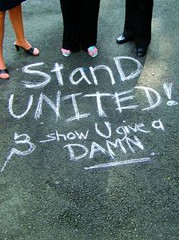
What is positive activism?

There is a saying that the price of freedom is eternal vigilism. That wise old guy Plato also once said that the price of apathy towards public affairs is to be ruled by evil men.


When we suffer from crime, poor service, corporate exploitation or poor governance, many of the roots can be found in our very own apathy. When our actions are negatively impacted, we very well might be ruled by evil men - and I'm not necessarily talking about someone in government here.

How often do we not say that we just don't have the time to do anything? Or to claim that there is no point in trying because those in authority will not do anything? Or to claim that it is not our job to get involved - that's why we pay taxes?

From my early involvement in analysing crime, it is apparent that previous years' success against crime in South Africa drew on community involvement. As crime in Gauteng was reduced in the late nineties, apathy grew and community involvement dropped.

But the effects of apathy are not confined to increasing crime. They can be felt in the service we receive from public institutions or at retailers. They can result in lack of representation in government.

Activists are not born, they are made. Be it through an upbringing that encourages standing up for one's beliefs or through circumstance that convinces them to say, "Enough is enough."

I believe we need positive activists. People who are not dragged into confrontation and negative criticism, but constructive engagement. People who want to be part of the solution and not the problem. People who understand that there is a personal cost to enjoying progress.

The positive activist's manifesto is:
  • I understand that positive engagement yields quicker, better results than negative attack

  • I understand that should I wish to enjoy the benefits living in a community then I must contribute to that community

  • I understand that my contribution includes taxes and moentary contributions but is likely to require personal involvement

  • I will seek to be involved in solution before criticising

  • I will act rather than pass by

  • I will give positive feedback - where this is not possible I will ensure my feedback is constructive

  • I will escalate rather than give up.


The positive activist's goals are:
  • To promote action rather than argument

  • To promote accountability and results

  • To promote community involvement

  • To make a difference.


If you agree and want to be involved, then feel free to post the following code on your blog / site that links to this article:

<a href="http://itisthequestion.blogspot.com/2006/08/what-is-positive-activism.html"><img src="http://static.flickr.com/83/230343279_96b8171088.jpg?v=0"/></a>

This will put the following logo and link onto your page:

Update to a question: Corporate Criminals?

Just over a week ago (on the 21st August), I posted about illegal signs. I had informed the Johannesburg Metropolitan Council and been encouraged by their response.


I am happy to report that the signs have been removed (minus two that are on a servitude behind a fence, but the removal of those is in progress).

Congratulations to Jerome Thomas, Henda Boshoff and the Metropolitan Police for their swift action.

In addition, I have emailed the directors of the companies involved, and it appears that the Sandhurst Chronicle will run a story about illegal signage and this incident.

Lesson? YOU CAN MAKE A DIFFERENCE! Complaining at a dinner party and criticising authorities without doing your bit is not on.

Tuesday, August 29, 2006

How calm and collected are you?

"m'Lord, I'm sorry, but there is a snake next to the accused."

HA HA HA HA! Brilliant. This guy, a court interpreter in Ramsgate, KwaZulu-Natal, takes the cake for taking things in his stride.

For my overseas readers, a boomslang (Afrikaans for "tree snake") has a very dangerous neurotoxic venom. They grow to about 2 metres and their victim's only saving grace is that they are back-fanged, meaning they often don't get a great bite and inject a full load of poison. Nevertheless, they remain one of South Africa's most dangerous snakes, and they are quite common in all of sub-saharan Africa.

An African Boomslang Picture: animalpicturesarchive.com


From News24

Sssilence in court!
28/08/2006 23:13 - (SA)

Lucia Swart , Beeld


Durban - It wasn't a snake in the grass that caused all the drama at Ramsgate magistrate's court on the KwaZulu-Natal South Coast on Monday - it was one in court.

Court interpreter R S Madlebe was speaking just after noon on Monday when he suddenly switched to English: "m'Lord, I'm sorry, but there is a snake next to the accused."

Magistrate Charlotte Dickinson said a green boomslang slithered into sight.

"It was hot and the case was becoming quite drawn-out just before lunch.

"The interpreter was droning on in a monotone. He was in the middle of a sentence when suddenly, without moving a muscle or blinking an eye, he apologised and told me there was a snake," said Dickinson with a laugh.

She adjourned the court and everyone scurried out. The accused was taken back to the court cells.

The court orderly caught the snake (which was about half a metre long) and released it outside."


Just another day in Africa!

Monday, August 28, 2006

Could you overcome your pride?

Former apartheid minister of safety and security Adriaan Vlok's gesture towards repenting for his role in apartheid is striking. He washed the feet of someone who he felt symbolised apartheid victims, the Reverend Frank Chikane.

Even if you are not a Christian, the symbolism is moving. In a statement released jointly with Chikane today, he descibes the importance of giving up his pride in the action.

Vlok did not seek any publicity for the move - Chikane discussed the meeting after it happened, and when approached by the press, Vlok deflected questions to the Reverend.

The action has since been praised by President Mbeki, who described Vlok's actions as an extraordinary and moving gesture of reconciliation.

The meeting follows a statement by Archbishop Tutu some months back criticising whites for their lack of contrition for apartheid wrongs.

Well done Mr Vlok.

More on News24.

Thursday, August 24, 2006

Is corruption a white issue?

My last couple of posts have focused on the role of race in argument and the credibility thereof.

Tony Yengeni Photo: IoL
Today saw the admission of Tony Yengeni into prison to begin a four year sentence for not declaring a discount received on a Mercedes Benz from Daimler Crysler - a bidder in the arms deal Yengeni was party to.

There has been much outcry. Western Cape provincial ANC chair James Ngculu said that it was not as though Yengeni had stolen something - he had merely failed to declare a discount. Well Mr Ngculu, next time an agent of yours, perhaps in a housing deal, takes a cut from the other party to your prejudice, tell me they merely made a mistake. As an elected representitive, that is what you are - our agent.

President Mbeki chose this time to comment on a tough stance against corruption in his newsletter, ANC Today. Congratulations to him.

And after the shocking news that convicted criminal Brigadier-General Ernest Zwane had been appointed the South African Defence Force's director of prosections, Defence Minister Mosiuoa Lekota, who arrived back in South Africa on Thursday, announced that Zwane had been sacked. He has launched a probe into the selection procedures. Well done Minister Lekota.

Also in the news today is that Archbishop Emeritus Desmond Tutu has told Jacob Zuma to do the honourable thing and forget about the presidency. While Tutu acknowledges that Zuma is a likeable man, he believes his sexual misconduct is inexcusable. Well done Archbishop Tutu.

What's the point of this post? Each of these issues is well removed from the struggling township dweller. They are seen as largely white issues. The calls for men of the people to be jailed are seen as racist in nature and the reaction is one of opposition rather than logic. For logic to prevail and South Africa to progress, debate for and against cannot be white versus black. Well done to Minister Lekota, President Mbeki and Archbishop Tutu for taking the moral high ground.

Monday, August 21, 2006

Do you work for a criminal firm?

The intersection of Sandton and Grayston Drive has become a veritable forest of billboards and signs - illegal and legal.

Controversy reigned about two years ago when one of the billboard companies merely chopped down the trees along the road in order to give motorists a clear view of their sign.

Others have proved equally bold - merely erecting massive signs on the pavement to advertise their services.

Enough is enough. We can complain about crime yet become complicit by acts like these - or working for companies with these ethics.

Further, most people are "too busy" to do anything. It's easier than you think to take a stand. After some trouble (20 minutes) phoning Joburg Connect (011 375 5555) I was put in touch with a very helpful gentleman called Jerome who asked me to note the names of the companies and email these to him. He would then do a site visit and begin the process against the offenders.

You might say, "Oh but he's probably too busy to care."

I would say not from his helpful attitude. Further, the DA informs me that the special court dedicated to Johannesburg bylaw transgressions only saw 13 cases for the whole of last year (DA representative - community crime meeting, 31 August 2006). 13!! If you want to see the amazing list of bylaw categories, click here. Then tell me the problem is not resident apathy.

Well I believe the time has come for positive activism. I'll post a separate thread on that.

In the meantime, let this post act as a name and shame catalogue for the companies involved. By all means, phone them and tell them what you think. Imagine you lived on the adjacent properties and let them know how you disagree.

Here's the astounding photo evidence:


And here are the telephonic details of each firm involved:

Interprise Broadband - 0861171717
DTZ Leadenhall - 011 2742300 - Natasha - 0829049631
Pam Golding - Pam - 0827759598
Sotherbys - Derek Ballantyne - 0827456390
Bradford McCormack - 0114429111
Chelsea Manhattan - 0117832111 - Mark - 0829406856
Auction Alliance - 0114305555 - Craig Hean - 0824449598

If you think the signs behind the fence might be OK, you're wrong - they're on a servitude. This I know from researching the area on www.joburg.org.za (awesome website) and the Joburg GIS - http://ims.joburg.org.za/. An activist needs to know what tools are at his disposal!

Here is the map of the relevant area from the GIS* with the signs' location indicated by a red dot.


It is time to fight. Do not accept wrongs through apathy. Become an activist for positive change.

* As an aside, the GIS has all sorts of useful information, including tagged 2001 census data.

UPDATE: My email was sent to the Johannesburg Council at 20h00 last night. By 12h00 today I was copied on emails instructing the Johannesburg Metropolitan Police Department to remove the signs and begin legal proceedings against the companies involved.

Would it make a difference if Tony Leon was black?

Interesting question. Posed by Cyril Madlana in his Business Day column.

It seems that the Business Day has unwittingly hosted a thread of would the argument be received differently if the person was a different colour columns - which I have consciously picked up on (see my comment on Professor Xolela Mangcu and Professor Anton Harber's articles).

Madlana's commentary is interesting. He quotes Roger Burrow's (head of the Democratic Alliance for KwaZulu-Natal) retirement speech, in which Burrows laments that many followers of his party believed votes would come to them "because our policies and principles are so right." This did not happen.

Madlana says that, "Much has been made of Leon's abrasive and confrontational style of opposition politics and how Africans' sense of respect for authority is violated when he challenges the president, for instance."

Despite Leon's style, Madlana draws attention to the fact that the DA (while remaining small) has grown while many traditionally black opposition parties have struggled.

Madlana ends by saying that, "There are signs that some communities want to be ungovernable again in protest at failure of the authorities to deliver on promises. Would the country rather burn than pause to think whether there is any sense in what a white, DA-supporting Burrows, Leon or Eddie Trent are saying?"

I found the article interesting in light of my recent contact with the DA and Tony Leon in particular. Post a meeting regarding crime, I approached Mr Leon to offer my opinion on the DA performance during the evening. I introduced myself and noted that I had found the experience of the DA statements and comments during the evening an incredibly negative one. The DA national spokesperson on safety and security, Ms. Dianne Kohler-Barnard, had devoted much of her speech to attacking the Minister of Safety and Security, Minister Charles Ngakula, and National Commissioner of Police, Jackie Selebi. I mentioned that I was not a DA supporter for precisely this reason - I disagreed with the DA's style of negative opposition politics. I wondered if the DA might attract more voters like me (young, proudly South African) if they played a more constructive role.

Mr Leon appeared to lose interest and said he thought he had made quite a positive speech. He suggested that I continue to vote for whoever I did.

The lesson in all of this is, I hope, that the manner in which arguments are received is not merely an issue of race. It is one of commonality. When I made my observations known to Mr Leon, I had unwittingly been drawn into the DA style of engagement. Skilled negotiators know that we all tend to be drawn into the dominant style of an interaction. That style might be established through body language, tone of voice or turn of phrase. It takeconsciousious effort not to be drawn into a negative spiral.

As I mentioned in my comment regarding Professor Harber's article, we look for commonality or difference in the characteristics of the person we disagree with. Difference allows us to feel safe in our different point of view.

Tony Leon and the DA have different points of view to the African National Congress. Their style of engagememphasizesises difference and makes no attempt at establishing commonality. The fact that they are largely a white party provides their dominant characteristic to become the notable point of difference.

Commonality then defines the ebbs, flows and ultimately the outcomes of arguments. We look for commonality how others' views are put forward against our own. Failing to see this we look for differences in the critic's character, to justify why we might have a different point of view. And finally, our interaction style follows the dominant style or argument.

I regret that I fell into the trap - it is one that I try to avoid. I regret that my observations made to Mr Leon (and Ms. Kohler-Barnard) came across to them as negative criticism.

It is a failure that characterizesises politics. Mr Madlana's fears are appropriate. We need politicians skilled at building constructive dialogue. Whose views find common ground rather than negative space. Failing this (where the race of the sides is different), arguments deteriorate to the point that race becomes the accepted reason for disagreement.

Saturday, August 19, 2006

Should your race affect the merits of your argument?

In an astonishing counterpoint to the article from Professor Xolela Mangcu who argued that race often stands in the way of things being said, Professor Anton Harber writes of arguments in an online forum that were questioned once the contributor's race was questioned. She claimed she was black and questioned many black contributors' claims in the forum. When they disputed her race, her arguments were then also questioned.

It is fascinating reading the two articles (both from the Business Day). To my mind it illustrates the very roots of discrimination. We naturally look for commonality or difference. It defines the earliest social interactions we have. At pre-school level kids might find themselves part of a group or out of it based on a subtle attribute such as an accent. That grouping becomes all the more stark when we argue and instinctively look for support from those like us. When the argument itself is about discrimination, we become intolerant of those like us taking a different view - because it threatens our sense of who we are.


Professor Anton Harber's article can be found on his blog, The Harbinger.

Thursday, August 17, 2006

Do you understand black conciousness?

This article appeared in today's Business Day.

It is one of the best written pieces I have read in some time.

It decries the labeling - in order to quash argument - of the originators of different points of view as racist, and calls for greater tolerance.

It is balanced and introduced me to a commentator I did not know of. Professor Mangcu, thank you for a very well considered point of view.

From the Business Day:

A tribute to two good white men who fondly remembered Biko
Xolela Mangcu

THIS is a belated tribute to two good white men who died recently — journalists Robert Amato and Barry Streek.

I had an indirect relationship with Amato through an interview about my resignation from the Human Sciences Research Council. Towards the end of the interview he caught me off guard with what I initially thought was a rather cheeky rhetorical question: “But Dr Mangcu, it is generally believed you are difficult?” I was still mumbling something about standing on principle when he offered an answer to his own question: “Is it perhaps part of the black consciousness quest for authenticity?”

It was clear to me that his understanding of authenticity was far more sophisticated than the stock-in-trade racial nativism we have now.

After all, black consciousness never had an essentialist approach to political authenticity. Authenticity was always a matter of choice and identification, not birth or ancestry. I am sure our nativists would have been disappointed to learn from Kwame Anthony Appiah that etymologically the word “native” refers to all individuals born in a country, and not, as is often assumed, to those who claim authenticity on the basis of biology or ancestry. In that sense, we are all natives now.

There is also another reason why we should move away from nativist conceptions of authenticity. The ideal of authenticity has been central to the modern democratic revolution.

Or as the Canadian philosopher Charles Taylor puts it: “To see what is new in this we have to see the analogy to earlier moral views, where being in touch with some source — God, say, or the Idea of the Good — was essential to full being. Only now the source we have to connect with is deep in us. This is part of the massive subjective turn of modern culture, a new form of inwardness, in which we come to think of ourselves as beings with inner depths.”

However, freeing oneself from vertical hierarchies was never seen as a way to sever horizontal relations with society. Our individuality has always been dependent on the social relations we have with others. Hence Taylor’s assertion that “my discovering my identity doesn’t mean I work it out in isolation but that I negotiate it through dialogue, partly overt, partly internalised with others... my own identity crucially depends on my dialogical relations with others”.

Kwame Appiah expresses the same idea this way: “Individuality pre- supposes sociability.” In isi-Zulu we say umuntu ngumuntu ngabantu. To wit, horizontal relations are vital to the formation of both individual and national identities.

My concern is that in our country we have developed an intolerant culture in which we disqualify those we disagree with by labelling them racists. We often do not know and have never met the people we accuse of racism. Nor do we want to inquire about the reasoning behind their arguments, lest those arguments deprive us of the favourite pastime of throwing racial epithets.

This argumentation by epithets is one of the most dreadful aspects of the new political culture. Instead of engaging in a dialogical process by contesting ideas as ideas we opt for racial clairvoyance and reflexive dismissal of our critics even before they speak on account of their race. Unfortunately, this seems to be working, especially among white people.

Throughout the times I have organized public lectures I have always been struck by the silence of white people. They are afraid to speak, lest they be insulted or marginalised. And so they resort to anonymity, or to expressing outrage in the privacy of their homes or in bar-room talk.

What we all lose in the process is the ability to fashion, through open dialogue, an inclusive, authentic national identity through the horizontal relations of our civil society.

This national identity would come out of what Steve Biko called the “joint culture” comprising both the black and the white experience. Whether we like it or not, our fates are inextricably tied to each other.

Unfortunately the culture we breed now is also the culture we bequeath to our children — a bifurcated political culture in which black kids feel entitled to speak in public and white kids feel automatically disqualified from speaking. We need to inculcate in our children that this country belongs to all of them, and that none of them should feel less native than others.

If there is anything I admired about Amato and Streek it is that they never shirked their responsibility to speak in public. I will never forget the day Barry assembled a whole group of former National Union of South African Students members at his house so I could interview them about Biko’s impact on white student politics. Even though Biko was the fiercest critic of their liberalism, they respected his intellect and remembered him fondly. That’s because he never insulted them.

‖Dr Mangcu is visiting scholar, Public Intellectual Life Project, Wits University. He is also a nonresident WEB DuBois Fellow at Harvard University.